Blog/
Benefits of Mind Mapping
Mind maps boost memory, simplify complex ideas, and support creativity.
Why mind maps work
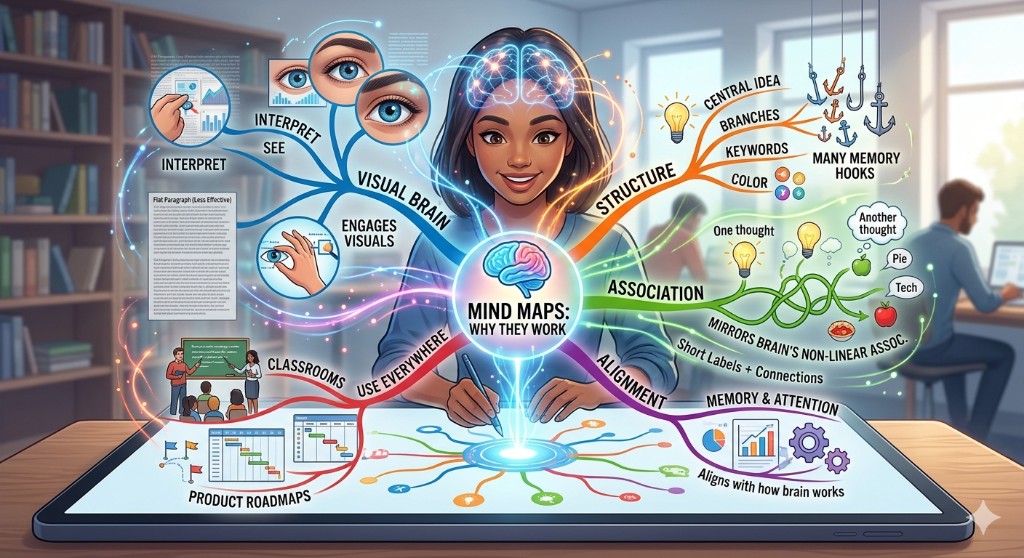
Much of the brain is built to interpret what you see. When you turn notes into a map—a center idea with branches, keywords, and color—you give your memory more hooks than a flat paragraph. Short labels plus connections mirror how associations actually form: one thought leads to another, often in a non-linear way.
Mind mapping is not magic, but it aligns the page with the way attention and memory already work. That is why the technique shows up everywhere from classrooms to product roadmaps.
What is mind mapping?
A mind map is a visual thinking layout: a central theme (a question, project, or concept) with ideas branching outward. You summarize with keywords or short phrases, and you can use color, icons, or images to separate themes and make scanning easier.
The basics stay the same whether you sketch on paper or use software:
- One central idea anchors everything.
- Branches show relationships at a glance.
- Keywords keep nodes light; detail lives in notes or linked docs.
- Visual cues (color, shape, imagery) speed recognition when you revisit the map.
Brief history
People have organized knowledge in tree-like and radial diagrams for centuries. The term mind map became widely known in the 1970s through educator and author Tony Buzan, who popularized the method as a study and creativity tool. Today it is a mainstream practice in education, business, and personal planning—often paired with digital canvases and collaboration.
Who uses mind maps?
Mind maps adapt to almost any domain:
- Students and teachers for note-taking, lesson outlines, revision, and project planning.
- Professionals for strategy, meeting capture, problem framing, and stakeholder alignment.
- Writers and creators for plots, content calendars, and research webs.
- Anyone planning life goals—career moves, habits, weekly priorities—when a list feels too flat.
If your thoughts jump between topics, a map can hold the shape of that jumpiness instead of fighting it.
Key benefits of mind mapping
Better memory and recall
Maps emphasize relationships. When you review, you are not re-reading a wall of text; you are walking branches. Colors and placement act as retrieval cues, so “where on the map was this?” becomes part of how you remember.
Break down complexity
Big subjects shrink when you break them into first-level themes, then sub-branches. Each node stays small; the structure carries the complexity. That makes it easier to spot gaps, duplicates, or missing steps.
Faster comprehension
Linking new information to what you already know is easier when you can draw the link literally. A branch from “known” to “new” is a commitment: you have named the relationship, not just stacked facts.
More creative thinking
Radial layouts encourage divergent thinking (many options from one center) and lateral jumps (unexpected bridges between branches). You are less likely to trap yourself in a single narrative thread the way linear notes sometimes do.
Smarter problem-solving
A useful map-based workflow often looks like this:
- Name the core problem or outcome in the center.
- Branch out evidence, constraints, and stakeholders.
- Prune or merge until the map reflects only what matters.
- Highlight dependencies and decisions.
The map becomes a shared picture of the problem space—not only the “answer.”
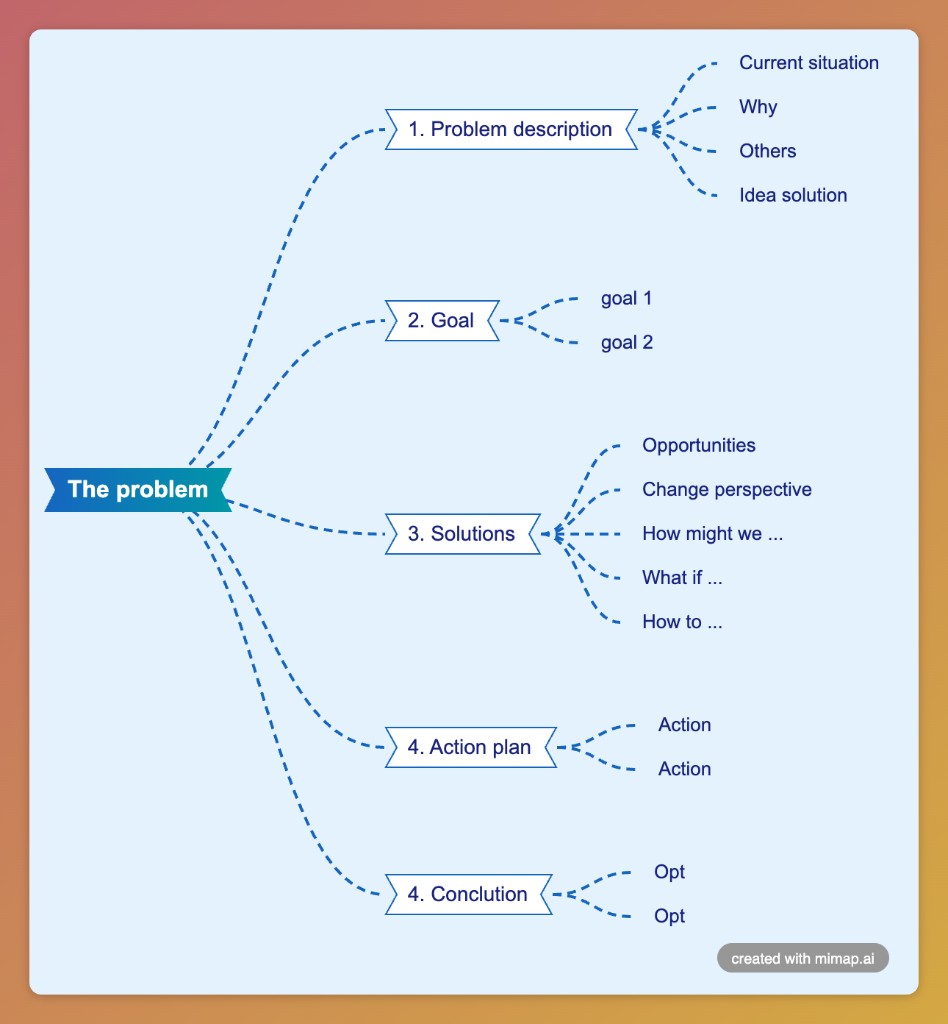
Below is a problem-solving template you can reuse in Mimap: the center names the issue, then branches cover the situation, goals, solution angles, a simple action plan, and a short wrap-up—handy when you want a scaffold instead of a blank canvas.
Learning
Students of different ages, learning levels, and interests can all benefit from mind maps. If you are a visual learner, this format is especially effective. You can apply it to note-taking, brainstorming, essay planning, project and research planning, or revision before exams.
Mind maps also make studying more engaging: instead of passively reading long text, learners actively organize ideas in a structure that makes sense to them. For visual learners, colors, icons, and simple visual cues help narrow focus, reinforce key topics, and make review sessions less tiring.
Mind maps with Mimap
Mimap is built for this exact workflow: interactive mind maps plus AI so you are not staring at a blank canvas.
- Generate from a prompt to get a first structure in seconds, then edit freely.
- Bring in longer sources (for example documents or video) when you want a map that reflects real material, not only a brainstorm.
- Themes and layouts help you keep maps readable as they grow.
- Export and sharing let you hand off PNG, SVG, PDF, JSON, and more—or share a public view when context should live outside a doc.
You still own the thinking: AI proposes; you refine, cut, and connect until the map matches your understanding.
Quick start
Pick one topic you are learning or one decision you are weighing. Keep the first level to five branches or fewer, use short labels, and revisit the map after a day. If you want a head start, sign up for Mimap and generate a draft map from a short description—you can always trim it back.
Ready to map your next idea?
Create mind maps from a topic, web page, or YouTube with Mimap.
Get started freeView pricing