Blog/
What Is Visual Learning?
What is visual learning? See how visual learners use mind maps for memory, note-taking, and study-and create your first map free with Mimap.
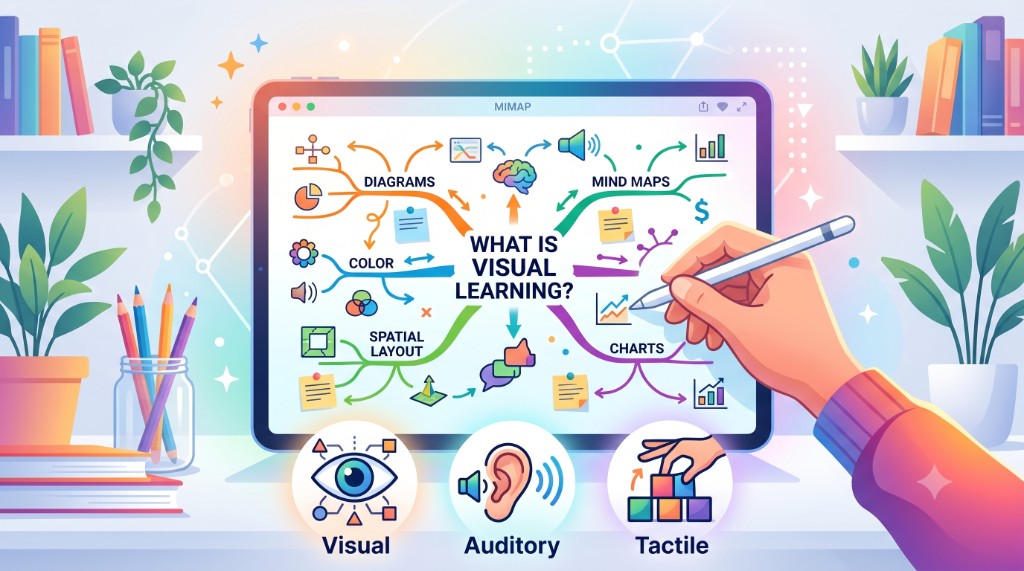
Visual learning is a learning style where you understand and remember information best when you can see it-through diagrams, color, spatial layout, and structured graphics-not only when you hear or read long paragraphs.
If color-coded notes, charts, or sketches help you think, you are likely a visual learner. Mind maps are one of the most effective tools for this style: one central topic, branching ideas, and visual cues you can scan in seconds.
New to the format? Read benefits of mind mapping for a broader overview.
Visual, auditory, and tactile learning styles
Most people lean toward one of three common learning styles (many blend two):
| Style | How you learn best | Tools that help |
|---|---|---|
| Visual | Diagrams, color, spatial layout | Mind maps, charts, highlights |
| Auditory | Listening, discussion | Lectures, podcasts |
| Tactile | Doing, building | Practice, prototypes |
Rough estimates often put visual learners at about two thirds of people, auditory learners less, and tactile learners the smallest group.
The useful point is simpler: match the format to how you review material.
For visual learners, mind mapping is a strong default-a center topic, branches, and visual grouping that mirror how memory links ideas.
Why visual learning works
There is no “wrong” learning style-only a mismatch between format and habit.
- Visual formats match modern life - Slides, video, and on-screen docs are already visual; mind maps and diagrams often beat walls of text when you revisit.
- Layout aids memory - You may forget yesterday’s wording but still recall where an idea sat on a branch or which color marked a theme.
- Maps beat paragraphs-for many people - Visual layouts can improve retention and comprehension versus text-only notes. If you learn by seeing, mind maps usually feel faster to absorb and review.
What is a mind map?
A mind map is a radial diagram used for visual thinking:
- A central idea anchors the page
- Branches hold sub-topics
- Sub-branches use keywords-not full sentences on every node
Use a mind map to recall, brainstorm, or break down complex topics.
Core pieces (on paper or in an app):
- Center - one theme or question
- Branches - related ideas, not a forced top-down list
- Keywords - short labels; longer detail in node notes
- Visual cues - color, emphasis, grouping
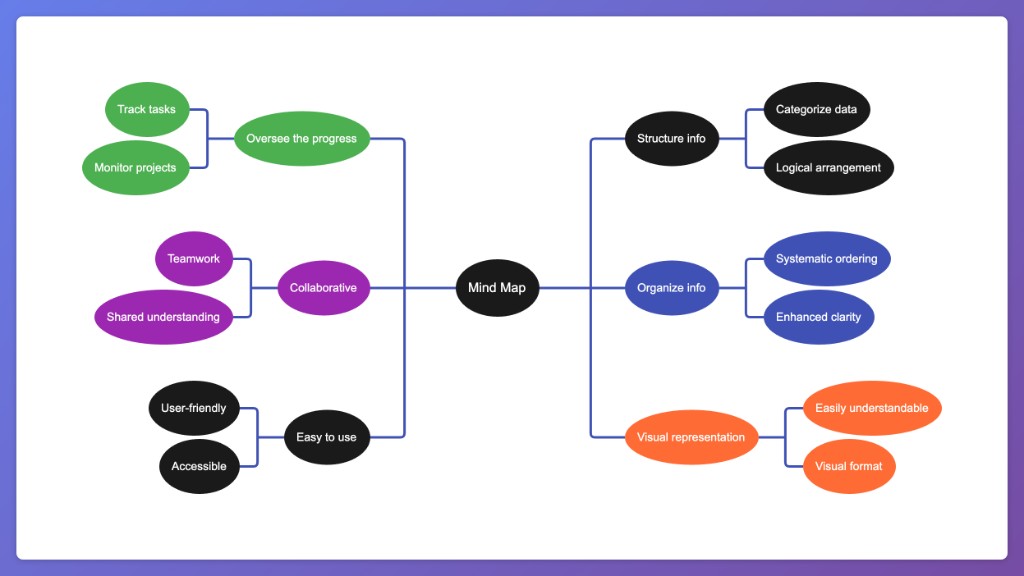
From the center, branches often cover how you:
- Structure and organize information
- Present ideas in a visual format
- Break work into parts you can track-alone or via a shared link others can view
Mind maps for visual learners
Memorization
Color, grouping, and position become memory hooks-you walk the map instead of rereading dense text. This is why mind maps for visual learners are popular for revision and exam prep.
Creative thinking
Branches let you explore one topic from many angles without locking into one linear storyline.
Problem-solving
- Put the problem or goal in the center
- Branch out facts, constraints, and options
- Prune until only what matters remains
- Add decisions and next steps
Everyday uses of mind maps
-
Note-taking - Keywords and branches beat long transcripts for visual learners.
Tip: Keep first-level branches to five or fewer while capturing live; add detail on sub-branches later. -
Brainstorming - One trigger in the center, many ideas on branches. Share a public link when others need to view your map.
-
Organizing - Combine readings, lectures, and your own thoughts in one structure; spot gaps and duplicates quickly.
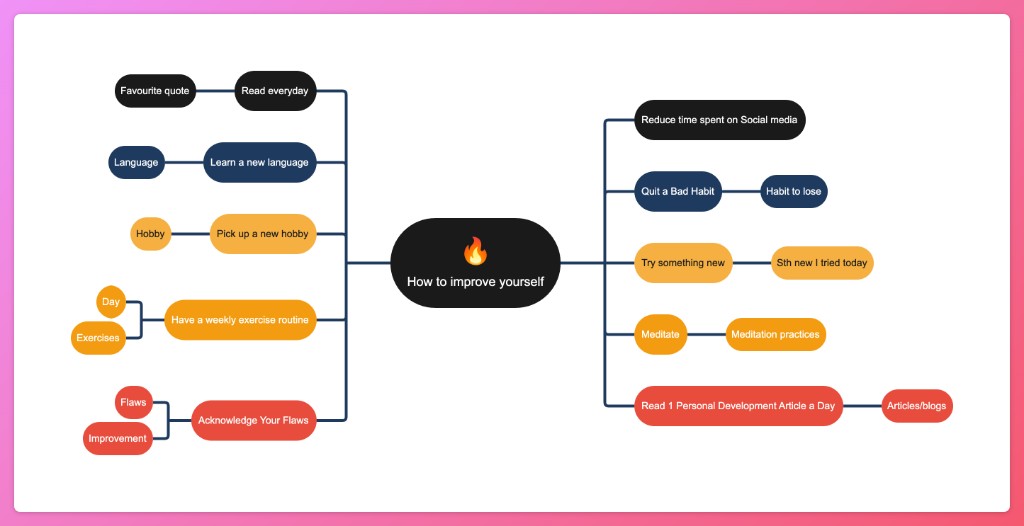
The same format works for personal goals-habits, learning plans, or weekly priorities-when a flat list feels hard to scan.
Students can apply the same approach with lecture notes and articles-see mind maps for students.
Frequently asked questions
What is visual learning?
Visual learning means you process and retain information more effectively through visual input-charts, diagrams, color, video, and spatial layouts-compared with long spoken explanations or unstructured text alone.
How do I know if I am a visual learner?
You may be a visual learner if you prefer diagrams over dense paragraphs, use color to organize notes, remember where something appeared on a page or map, and find mind maps or charts easier to review than audio-only study.
Are mind maps good for visual learners?
Yes. Mind maps for visual learners match how this style works: keywords, branches, color, and layout give quick visual anchors for memory, note-taking, brainstorming, and problem-solving.
How can I start mind mapping for free?
Pick one topic, add a center node and a few branches, and use color to group themes. With Mimap you can build unlimited maps by hand, export PNG or PDF, share a public link, or optionally generate a first draft with AI-create a free account to begin.
Get started with Mimap
- Pick one topic or decision
- Add a center idea and a few short branches
- Use color to separate themes
- Revisit after a day and adjust until the layout matches how you think
Mimap is a mind map editor with drag-and-drop, themes, layouts, and styling.
You can:
- Build mind maps manually from a blank canvas
- Export to PNG or PDF
- Share a public link when others need to view your map
- Optionally use AI for a first draft from a topic or pasted text-then edit every branch until the map is yours
Create your first mind map - free to start
Related: Mind maps for students · Benefits of mind mapping
Ready to map your next idea?
Create mind maps from a topic, web page, or YouTube with Mimap.
Get started freeView pricing