Mimap for language learners

Learn a language
as a mind map

Start from a topic, an article, notes you are studying, or a video. The branches stay in the language you speak. Every phrase is a study card in the language you are learning: pronunciation, your meaning, two examples, a usage note, and related ways to say it.

Free account · No credit card · At least 24 study cards
  • English
  • Tiếng Việt
  • 日本語
  • 한국어
  • 中文
  • Español
  • Português
  • Français
  • Deutsch
  • Bahasa Indonesia
  • ไทย

A sample map

Situations in your language, cards in the one you are learning

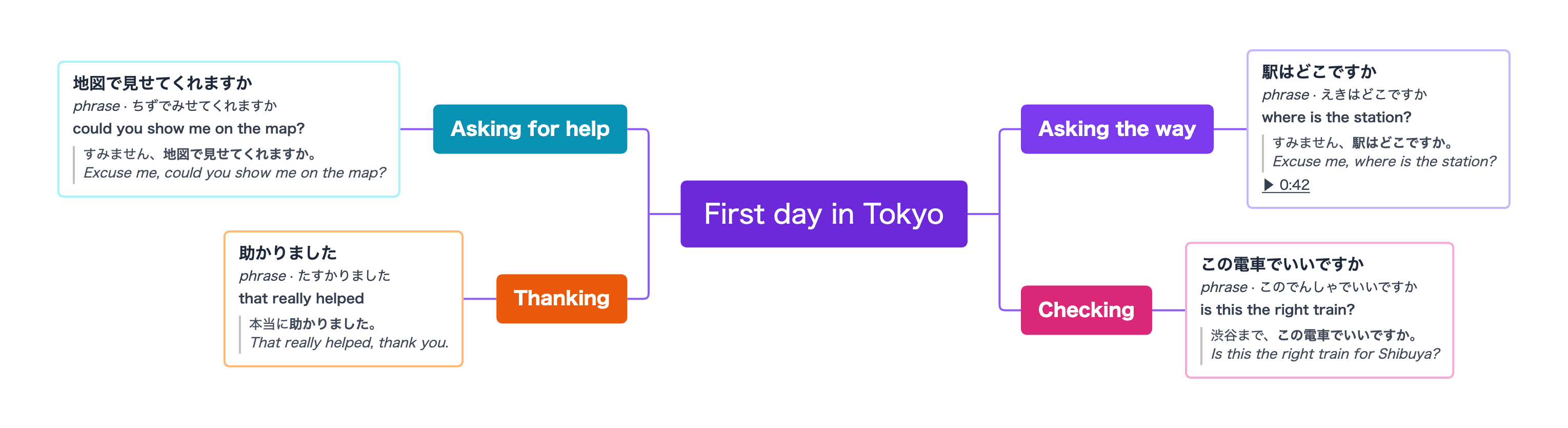
A first day in Tokyo: four scenes in English, and a Japanese phrase card under each one.

Sample language map for a first day in Tokyo: Asking the way, Checking, Asking for help, and Thanking, each with a Japanese phrase card

What a card contains

A study card, shown in full

The whole card is visible: the phrase, the sentence it came from, and how to use it. It is an ordinary note you can edit in the map.

phrase · えきはどこですか

駅はどこですか

where is the station?


すみません、駅はどこですか。

Excuse me, where is the station?

この近くの駅はどこですか。

Where is the station near here?

Polite, for a stranger. With a friend, 駅どこ? is enough.

  • どちらですか: which way is it?
  • この辺ですか: is it around here?

Example card: Japanese phrase, explained in English. Your map uses the languages you pick.

  1. 01

    The phrase

    Bold, and copied from the source when there is one. Multi-word phrases and collocations come before single words.

  2. 02

    Type and pronunciation

    Noun, verb, adjective, phrase, or pattern. Japanese uses furigana, Chinese pinyin with tones, Korean romaja, and other languages IPA.

  3. 03

    Meaning in your language

    One short line. The map around the card — titles and situation branches — is in the language you speak.

  4. 04

    The sentence it came from

    The real line from your article, notes, or video, with your translation under it. A topic with no source text gets a natural everyday sentence instead.

  5. 05

    A second situation

    Another short sentence, in a different scene, so the phrase is not tied to a single line.

  6. 06

    How to use it

    Nuance, politeness, who you say it to, when not to use it, or a mistake learners make.

  7. 07

    Related ways to say it

    Two or three lines: a near-synonym, the opposite, or the same idea said more politely or more casually.

  8. 08

    A timestamp, only when the source is a video

    A YouTube card keeps the second the phrase is spoken. The ▶ link opens the player inside Mimap. Other sources skip this.

Tell it what you want to practise

The same source can become a vocabulary map, a grammar map, or a conversation map. Pick a focus next to the language you speak and the language you are learning.

Auto

Follow the material

Vocabulary first. A branch usually also holds one grammar or conversation card when the source supports it. Culture tips stay as short notes in your language.

Vocabulary

Phrases, then a review

Every card is a word, collocation, or idiom. The map closes with a Review table: phrase and meaning, in the same order as the cards.

Grammar

Patterns with their forms

Each card is a pattern, such as “used to + verb”. It includes affirmative, negative, and question forms. Branches group patterns by what they do — tense, requests, politeness.

Conversation

Lines you will actually say

Each card is a functional sentence, with a two-line exchange so you see the reply. Branches follow the situations in the order you would meet them.

One map, from whatever you are studying

A topic or a situation

Type a scene such as “at the airport” or “first day in Tokyo”. Both examples on each card are natural lines for that scene.

An article, lyrics, or notes

Paste a URL or the text itself. The first example on every card is a sentence from that source, with your translation underneath.

A lesson on YouTube

Paste the link. We read the transcript, keep the sentence each phrase came from, and store the second it is spoken.

A title in your language

The root says what the material is, then two or three lines on what you will be able to do after the map.

Situation branches

Each branch is a scene — “ordering food”, “making a request” — with two or three sentences: where it happens, what usually comes before and after, and one tip.

Cards as the leaves

A map from this page includes at least 24 cards, at least two under each branch. Your level (Beginner, Intermediate, Advanced) skips what you already know.

A topic, an article, pasted notes, and a YouTube lesson all become the same map: situation branches in your language, study cards in the one you are learning.

Teaching a class? Share the map with a link. Students can read the cards without creating an account. A video source also lets them play each phrase.

Frequently asked questions

Which languages can I use?

You pick the language you speak and the language you are learning: English, Vietnamese, Japanese, Korean, Chinese, Spanish, Portuguese, French, German, Indonesian, or Thai. Branch titles stay in your language. Card headings stay in the language you are learning. Japanese cards include furigana, Chinese cards pinyin with tones, Korean cards romaja, and other languages IPA.

Does it invent example sentences?

When you paste an article, notes, or a video, the first example is a real sentence from that source, and the phrase appears in it exactly. The second example is a different situation, written so you see the phrase somewhere else. If you type a topic and there is no source text, both examples are common, natural lines for that situation.

What do Vocabulary, Grammar, and Conversation change?

Vocabulary keeps every card a word or phrase and adds a Review table at the end. Grammar makes every card a pattern and includes its forms. Conversation makes every card a sentence you would say, with a short A/B exchange. Auto mixes those types according to the source.

How many cards do I get?

This page builds a map with at least 24 phrase cards, grouped under situation branches in your language. A longer article, transcript, or set of notes still stays organised by scene rather than becoming one long list.

Can I edit a card or share the map?

Yes. A card is a normal note in the editor, so you can change any line. Share the map with a link: viewers can read the cards without creating an account. If the map came from YouTube, they can also play each clip.

Is it free?

Yes. A free account includes AI credits and does not require a credit card. Each map costs one credit.

Turn what you are studying into cards

Choose the language you speak, the language you are learning, your level, and a focus.

Make my phrase map
    Learn a Language as a Mind Map — Phrase Cards from Any Source | Mimap